
Understanding price revision formulas: the complete guide

Discover how price revision formulas work, their mechanisms, their advantages, the mistakes to avoid and how to calculate them in practice. A comprehensive, clear and illustrated guide to finally mastering this lever.
Introduction
Prices are constantly changing: raw material costs, energy, wages, transport, exchange rates, inflation... The entire economy is subject to structural volatility, which makes forecasting difficult, particularly for medium- and long-term contracts. For businesses, when conditions change between signing and execution, margins are distorted, economic balances are disrupted and commercial relationships sour — leading to renegotiations, tensions and recurring uncertainties. It is precisely to address this instability that price revision mechanisms were created, which are now essential in many sectors. In this article, we will look at:
- what a revision formula is
- how it works
- how to calculate it
- common errors
- and how to make it simple, reliable and quick to manage.
What is a price revision formula?
A price revision formula is a contractual mechanism that allows the price of a product or service to be recalculated at regular intervals, based on changes in one or more indices: raw materials, energy, wage indices, transport, exchange rates, macroeconomic indices. The aim is to maintain the economic balance of the contract for both parties.
Why use a revision formula?
- Transparency: Adjustments are no longer based on feelings or endless negotiations: they are based on published indices (materials, energy, exchange rates, wages, etc.). Everyone can check the sources, understand the changes and anticipate the impacts.
- Fairness: When costs change, one of the two partners always ends up absorbing more than the other. A well-defined formula automatically distributes the effects of volatility, preventing either party from being unfairly penalised by market movements beyond their control.
- Predictability: Variations are controlled, explainable and measurable. Purchasing, finance and sales teams can simulate the effects of indices, forecast scenarios, secure margins and easily justify the impacts to stakeholders.
- Stability: Instead of renegotiating with every market movement, the adjustment mechanism is built in from the outset. Discussions become more fluid, business relationships more relaxed and contracts more sustainable.
How does a revision formula work?
- Pt1: the revised price
- Pt0: the initial price
- a, b, c: the weighting of each component of the price
- I: the various indices that make up the price
Example
Let us imagine Company A, which signs a three-year contract with one of its suppliers in January 2024. The starting price of the product is set at €100, but both parties know that this amount cannot remain stable: manufacturing depends heavily on the cost of raw materials, energy and, to a lesser extent, wages. To secure the relationship, they therefore define a price revision formula with the following weightings: - 60% for materials, 30% for energy, 10% for wages. At the time of signing, the reference indices are: - Materials: 120 - Energy: 90 - Wages: 108 One year later, during the scheduled review in January 2025, these indices have changed: - Materials: 150 - Energy: 105 - Wages: 110 The two parties then apply the change ratios to each component of the formula: - Materials have increased from 120 to 150, a factor of 1.25 - Energy has changed from 90 to 105, a factor of 1.1667 - Wages have increased from 108 to 110, a factor of 1.0185 Based on these multipliers, the new contract price can be determined in a transparent and predictable manner that is acceptable to both parties.
Formula
Result
Based on these changes, the supplier and buyer obtain a new revised price, calculated in a mechanical, transparent and indisputable manner. There is no longer any room for arbitrariness: each variation is directly linked to the actual change in the indices, according to rules defined in advance and accepted by both parties. This type of example perfectly illustrates the benefits of a well-designed revision formula: - it protects margins, - limits unnecessary renegotiations, - and maintains a healthy commercial relationship, even in a volatile environment. In other words, revision is no longer a discussion: it is a method.
Memo
This is a simplified example; a formula can be much richer and more complex if more cost components are included or if exchange rate effects are incorporated.
The pain points
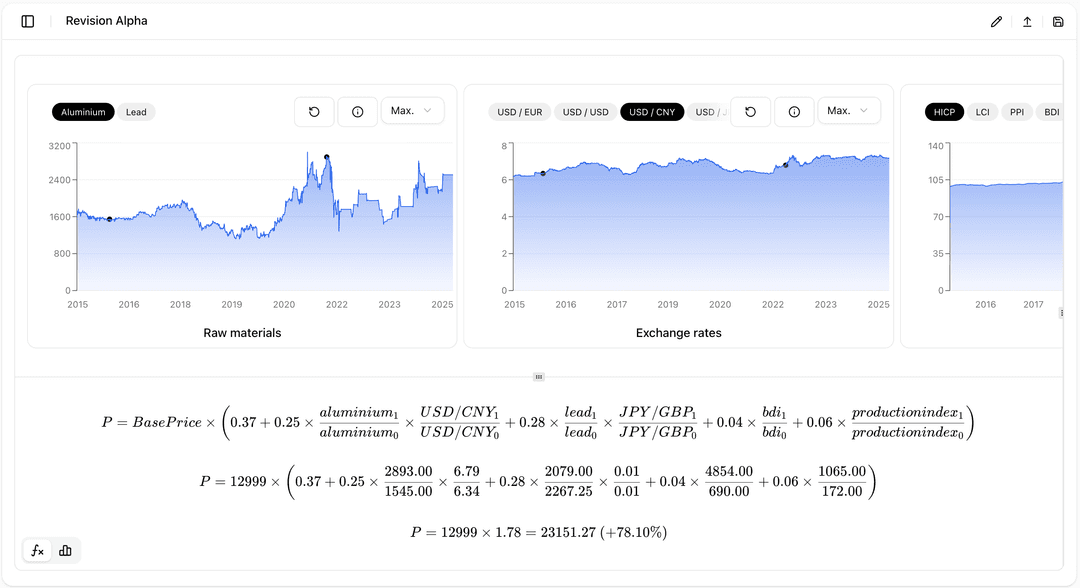
The real challenge is putting it into practice. As outlined above, establishing such a mechanism seems simple, but applying price revision formulas can be complex. In fact, some companies do not apply them in their contracts because the formulas can be poorly defined and contestable, the indices chosen are not always reliable, and managing them in Excel is too time-consuming and tedious. The result: significant financial losses, tensions with business partners, and precious time wasted manually checking and correcting files. It is precisely to avoid these pitfalls that Convexe steps in, centralising more than 50 official data series (raw materials, FX, indices) and making them available in a dynamic calculation interface: - You build your formulas intuitively - You visualise the impacts instantly - You export your PowerPoint presentations with a single click
Conclusion
Revision formulas are an extremely powerful tool, but their effectiveness depends entirely on how they are designed and implemented. When properly defined and applied, they not only protect your margins, but also streamline relationships with your suppliers and instil much-needed rigour, especially in volatile and unpredictable economic environments. To take full advantage of these mechanisms, it is essential to have a reliable system that eliminates human error, automates complex calculations and structures your revisions in a clear and transparent manner. This is exactly what Convexe offers: a modern solution that allows you to control your price revisions, save time, ensure consistency in your calculations and make your commercial decisions indisputable. With Convexe, every revision becomes simple, fast and secure, giving you the confidence you need to make the right strategic decisions.