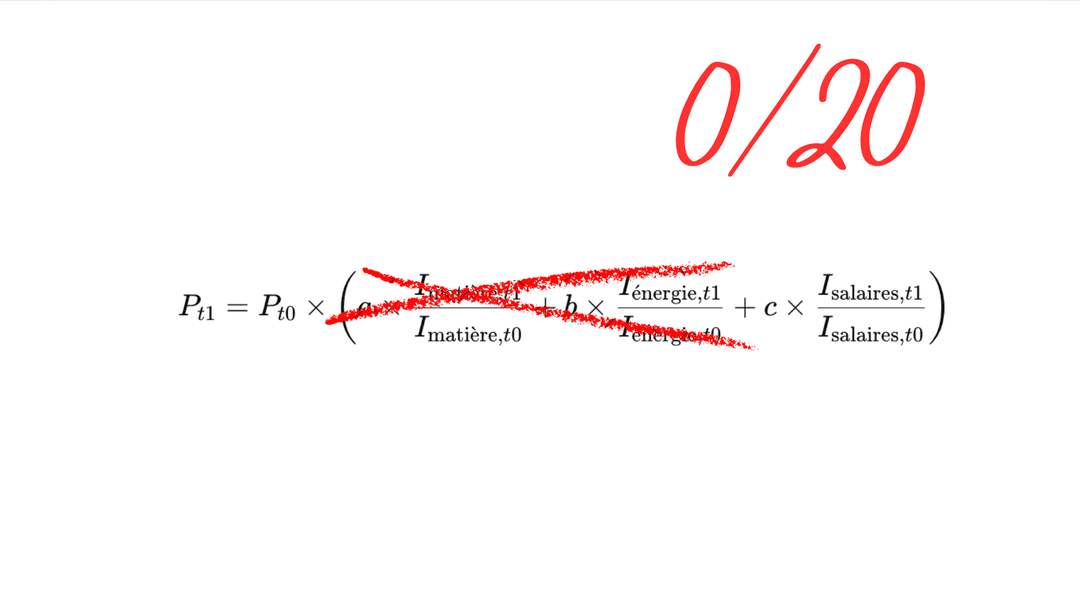
Price revision formulas: the most common pitfalls (and how to avoid them)

In this article, we will review the most common causes of price revision formula failure — those observed in practice — and, above all, how to avoid them.
Introduction
In many industrial and B2B contracts, the price revision formula is clearly stated. It is written in black and white, legally valid, and sometimes even sophisticated. And yet, in operational reality, it is only partially applied... or not applied at all. The result: eroded margins, misunderstandings with partners, constant renegotiations, decisions made on a whim. The problem is not the formula itself. The problem is its application. Before going into detail, it is essential to establish a clear principle: a poorly designed, poorly monitored or poorly applied revision formula has exactly the same effect as no formula at all. In a volatile environment (raw materials, energy, wages, exchange rates), this means: - cost increases absorbed by the company without any corrective mechanism, - margins that gradually deteriorate, often without immediate warning, - cumulative differences amounting to hundreds of thousands or even millions of euro over time. It is precisely for this reason that the real challenge lies not in the existence of a formula, but in how it is designed, managed and applied over time. Before even measuring its benefits, it is essential to identify the most common errors that compromise its effectiveness.
1. A poorly defined formula
This is the most common mistake. For the sake of speed (or contractual compliance), some companies reuse existing formulas: - from old contracts, - imposed by industry standards, - or copied as is from one customer to another. The problem is that the actual cost structure is never exactly the same. A 60% material weighting may have been relevant five years ago, but is now completely obsolete. An item that has become marginal may continue to weigh heavily in the formula, while a critical cost is not covered. The result is that the formula exists, but no longer reflects the economic reality of the contract.
2. Poorly chosen (or misunderstood) indices
A formula is only as robust as the data that feeds it. On paper, the index is ‘official’, “public” and ‘recognised’. In reality, it may be: - too generic, - too far removed from the material actually used, - published with a delay that is incompatible with the frequency of revision, - or very weakly correlated with the actual cost incurred. Under these conditions, the formula becomes questionable and difficult to defend. Each application triggers discussions, even disputes. Ultimately, teams end up not applying it anymore, due to a lack of credibility.
3. Ignoring inertia
A common mistake is to mechanically apply a formula without considering the actual gap between index changes and the effective impact on supplier costs. In many cases, changes in raw material or energy prices are not instantly reflected in the cost structure: there is inertia linked to stocks, upstream contracts or logistical delays. - A formula that is too reactive can lead to overcompensation for temporary increases. - Conversely, a formula that is too rigid may ignore already very real and lasting tensions. Failing to take this inertia into account amounts to creating a mechanism that is disconnected from economic reality, a source of disputes and gradual imbalances.
4. Revision frequency
The frequency of reviews must be carefully considered and not improvised. Reviewing too often or not often enough can be counterproductive. An annual frequency may be appropriate in a stable environment, but completely ineffective in periods of high volatility. Conversely, too frequent reviews in a slow-moving market make management more burdensome without any real benefit. When the frequency does not reflect the dynamics of the underlying costs, the formula becomes either ineffective or excessively burdensome: - Too high a frequency amplifies short-term noise. - Too low a frequency creates a lasting disconnect with the market. In both cases, the formula ceases to act as an economic buffer and becomes either unstable or obsolete. The challenge is to align the frequency of reviews with the actual dynamics of underlying costs, rather than with an arbitrary convention.
5. The lack of dedicated tools
In most organisations, revision formula management still relies on generic tools, mainly Excel. In principle, this may seem sufficient. In practice, however, this is often where the system breaks down. Formulas are scattered across multiple files, sometimes by supplier, contract or year. Index sources are copied manually, versions multiply, and traceability becomes virtually non-existent. As the number of contracts increases, the methodology becomes cumbersome, fragile and difficult to scale. - High risk of errors in formulas or index references - Lack of version control and reliable audit trails - Calculations that are not reproducible and difficult to explain - Simulations that are long and complex to produce - Heavy dependence on one or two key individuals Beyond the operational risk, this approach has a major hidden cost: time. Hours are spent verifying, recalculating, consolidating and explaining figures, without ever being certain that the result is accurate, complete or defensible. Worse still, this cumbersome process often discourages the rigorous application of formulas. Without the right tools, some companies end up postponing revisions, oversimplifying them or abandoning them altogether, turning a strategic contractual mechanism into an approximate exercise. It is precisely at this stage that the question is no longer whether a revision formula is needed, but how to manage it effectively, reliably and industrially.
How to avoid committing these errors
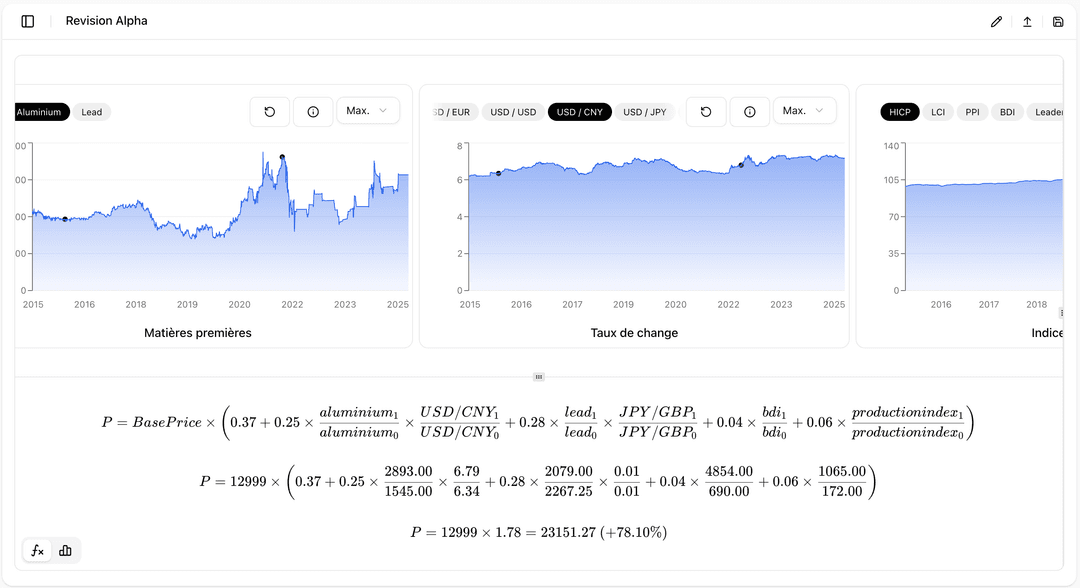
On paper, everything seems simple. In reality, price revision is a dynamic, complex and demanding process. Convexe was designed to address these practical issues. Convexe allows you to: - centralise indices (raw materials, energy, FX, salaries, etc.), - structure reliable and traceable formulas, - instantly simulate and visualise impacts, - centralise revisions, - clearly explain results, - produce comprehensive presentations in a single click (finance, sales, management). Price revisions are no longer a risky and time-consuming exercise. They once again become a controlled lever for protecting margins.
Conclusion
Price revision formulas are powerful levers, but their real value cannot be measured by their presence in a contract. It depends on their execution, over time, and on the organisation's ability to apply them rigorously and consistently. When poorly equipped or managed in an ad hoc manner, these formulas become sources of inertia, errors and silent losses. Conversely, when properly structured, monitored and explained, they provide lasting protection for margins, ease supplier relations and bring essential clarity in unstable economic environments. This is precisely where everything comes into play. Having a reliable system capable of automating calculations, securing data and making each revision traceable and indisputable is no longer a luxury but a necessity. Convexe meets this challenge with a modern, structured approach that puts you back in control of your revision formulas, eliminates operational weaknesses and transforms a complex mechanism into a powerful economic management tool.